E
Just a Tool
AI is becoming a functional tool, like any other functional tool.
Every transformative technology follows the same arc. The panic fades. The tool stays.
Every Tool Has Its Panic Phase
First it feels like magic. Then it becomes infrastructure.
The internet is a tool.
That sentence sounds obvious now. It wasn’t obvious in 1995. In 1995, the internet was the Information Superhighway. It was going to change everything. It was magic and danger and opportunity all rolled into one unknowable thing that half the business world ignored and the other half panicked about.
Now it’s a tool. You open a browser. You check email. You look up a contractor. You book a flight. The internet didn’t stop being transformative — it became so thoroughly woven into how business works that we stopped noticing it. It’s just there. Like electricity. Like running water.
AI Is Doing the Same Thing
AI is doing the same thing.
Not the AI of science fiction. Not the AI of tech demos and breathless Twitter threads and venture capital pitch decks. The actual thing. The language models that exist right now, today, that every software company on earth is racing to build into their products. That’s the tool.
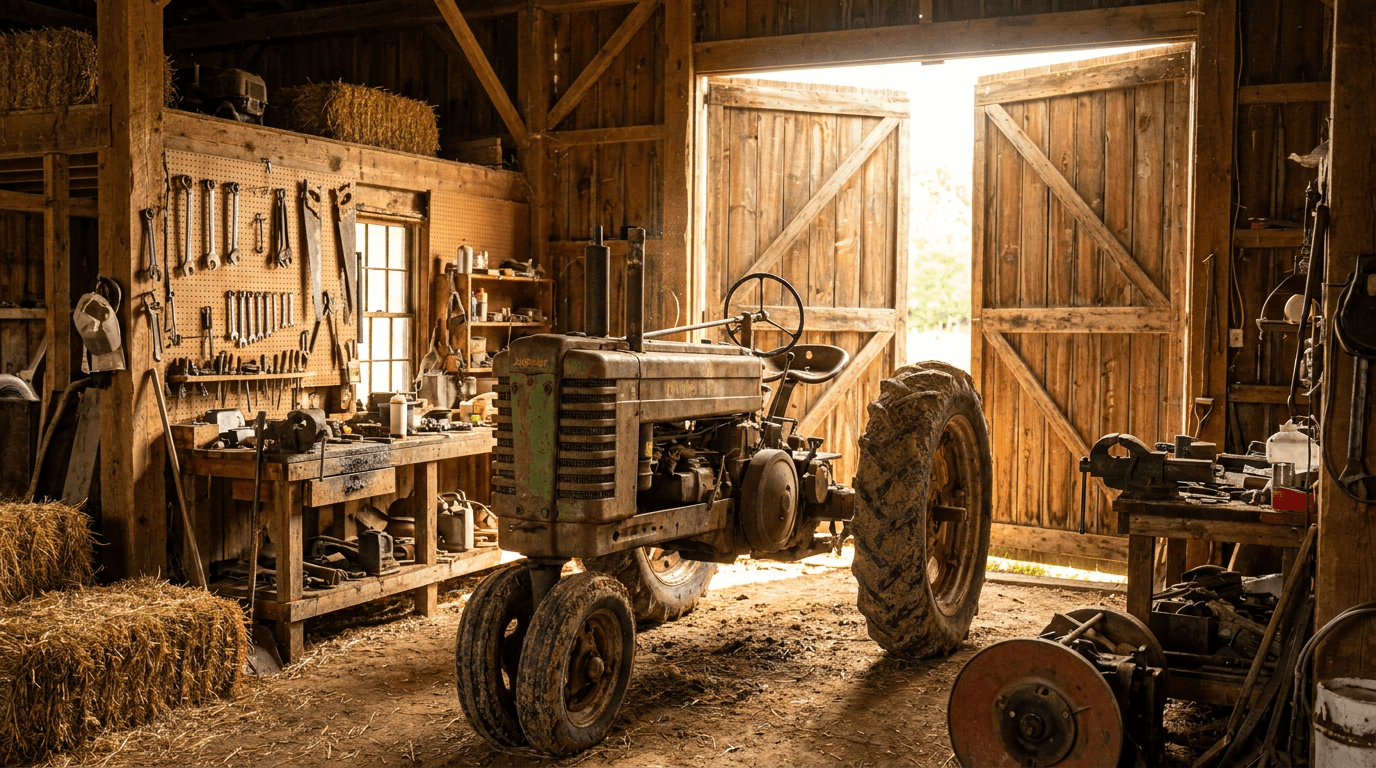
My grandfather didn’t buy tractors. He built them.
He left school after eighth grade to help the family through the Great Depression. Served as a paratrooper in Europe during World War II. Came home, got married, and spent forty years working rotating shifts at the paper mill in Augusta, Maine — first shift one week, second the next, third the one after that. Did that for decades. In between, he was a mechanic. A welder. A logger. A farmer. He and my grandmother had a woodlot way out in the woods where we’d go cut firewood — fell the trees, process them into logs, drag them out with a machine he built himself.
That machine was his own design. Took the body of a Studebaker and turned it into a logging tractor. Over the years, the Studebaker engine gave out and he replaced it with a four-cylinder Toyota, which he bolted to the original Studebaker transmission. Two transmissions. One machine. Torquey enough to haul anything out of the woods. Handmade winch. Handmade tow bar. Everything fabricated by a man working rotating shifts who spent his off-hours building the tools he needed.
He had a Case tractor for plowing. A bulldozer parked out back with a handmade wood splitter attached to the hydraulics. A log saw in the woodshed built around a four-foot blade salvaged from a logging operation. In the winter, he’d snowmobile to the paper mill when the roads were bad. In his spare time — because he always had spare time, somehow — he and his buddies built ultralight planes and flew them over the Maine woods.
That generation had a different relationship with tools. They didn’t buy them off the shelf and hope for the best. They made them. Modified them. Understood them from the inside out. My grandfather didn’t wonder whether a tractor was too complicated or too expensive — he built one from parts and proved it could work. His caution wasn’t fear. It was mastery. You trust a tool when you know how it works.
The Caution Is Part of the Process
Skepticism becomes the guardrail.
Every transformative tool follows this arc. The steam engine. Electricity. The automobile. The personal computer. The internet. Each one arrives wrapped in equal parts wonder and terror. Each one triggers predictions of ruin — jobs lost, skills devalued, communities disrupted, the end of things as we know them. And each time, the skepticism turns out to be healthy. Not wrong. Healthy.
Because the skepticism is what forces us to build the guardrails.
The people who were cautious about electricity are the reason we have building codes and circuit breakers. The people who worried about automobiles are the reason we have seatbelts and traffic lights and crash testing. The people who questioned the internet are the reason we have SSL certificates and privacy regulations and spam filters. The reluctance isn’t a bug. It’s the process that makes the tool safe enough to become invisible.
The Tool Becomes Invisible
Here’s the part that matters: we’re about at the plateau.
The language models are good enough. Not perfect — no tool is perfect. But good enough to do real work. Good enough that Google is embedding them into search results. Good enough that Microsoft built them into Word. Good enough that every project management app, every CRM, every booking platform is adding an AI feature that actually does something useful instead of just generating chatbot responses that sound smart and accomplish nothing.
This is the shift. The language model stops being the product and becomes the engine inside the product. You don’t buy “AI.” You buy software that works better because there’s an AI inside it doing the things AI is good at — summarizing, categorizing, remembering, retrieving, connecting dots that a human would miss.
The tractor analogy holds. Nobody went to the farm supply store in 1950 to “buy an internal combustion engine.” They went to buy a tractor. The engine was inside it. It made the tractor better than the horse. But the tractor was the thing you paid for. The engine was just why it worked.
Security concerns, practical limits, the boundaries of what a language model can and can’t do — all of that calcifies into conventions and best practices and accepted trade-offs, exactly like the internet did. You don’t post your social security number on a public webpage. You don’t expect a language model to replace a licensed therapist or a structural engineer. The guardrails become boring. That’s a good thing.
Boring tools are the ones that actually change things. The internet got boring, and then it rebuilt the global economy. Electricity got boring, and then it powered everything else. The tractor got boring, and then it fed the world.
AI is getting boring. Language models are becoming a functional tool, like any other functional tool. Not magic. Not a threat. Not a gold rush.
Just something you use to get work done.
The AI Operations System exists for exactly this reason — not to sell AI, but to put the tool to work inside a private server that builds institutional knowledge over time. The AI is the engine. The product is what it does.