E
The Architect of Grit: The Story Behind the Builder
The story behind Jones E Designs is not a polished agency origin story. It is a story about garages, inherited craft, self-reliance, and building systems from grit.
Built in Garages, Not Boardrooms
The workbench came first.
I didn’t start my career in a corporate office. I started in garages.
The Inheritance Was the Work
My grandfather’s garage, first. I had the privilege of being the kid who got to hang out with him while he worked on everything. He’d be bent over some piece of machinery — a tractor, a lawnmower, something that had stopped working — and I’d be right there beside him, watching. He never rushed. He’d take it apart, lay the pieces out in order, figure out what was wrong, and put it back together again. Not because he had to. Because that’s what you do when something breaks. That patience, that precision, that quiet focus of someone who knows what he’s doing — that’s where I first learned how to think.
My stepfather taught me cars, mechanical systems, carpentry. Different way of moving through the world — more hands-on, more instinctive. The logic of engines, the geometry of a good joint, the way materials behave under stress. Those lessons stuck not because they were explained to me, but because I did them. Felt them. The weight of a hammer, the grain of wood, the smell of motor oil after a long afternoon in the shop.
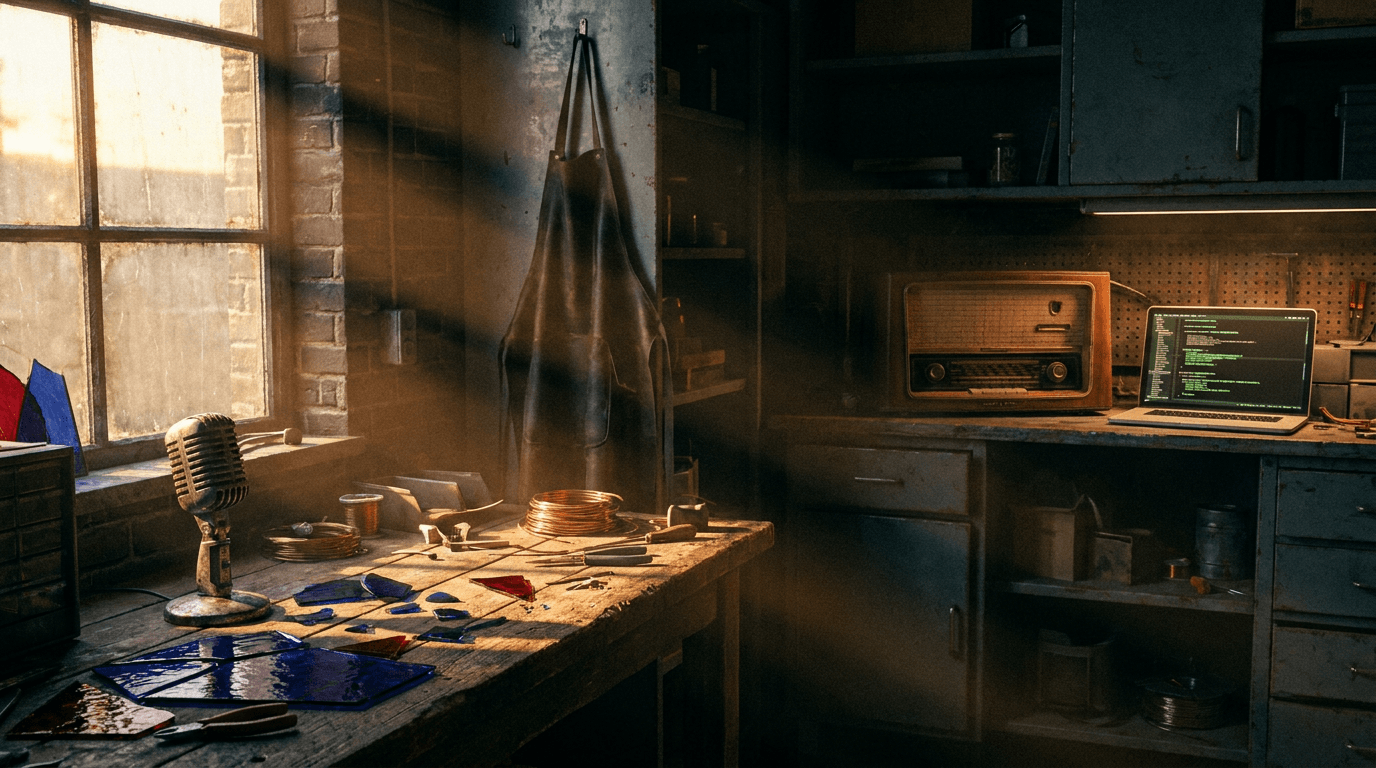
And my uncle taught me electronics and radios. That was different still. Signal flow. Circuits. The invisible architecture of sound and frequency — how you can’t see what’s happening but you can learn to trace it, predict it, shape it. That’s where I started to understand that not everything worth knowing is visible.
We did hard work too. Logging, hauling, farming. Living off the land. I don’t frame those years as struggle — I frame them as knowledge. Hard things teach you things soft things can’t. They teach you how to make something from nothing, how to fix what breaks, how to keep going when the work is heavy and nobody’s coming to do it for you.
I got a good education too, later. But the foundation was laid long before any classroom. Those fundamental skills — build, fix, listen, understand — they’re the same ones I use today. The materials changed. The approach didn’t.
The machine must be maintained. That was one of the first things I learned, and it’s never stopped being true. From my earliest memories, I was working — paper routes before sunrise, mowing neighborhood lawns, long days in the fields. I learned early that if you want a machine to run, you have to understand exactly how every gear tooth fits together. You can’t fake that. You can’t delegate it. You have to get your hands on it.
That work ethic isn’t something I read in a book. It’s something I built, with my hands, over years of practice and failure and getting back up. And it became the engine behind everything I’ve done since.
In the 90s, I found my way into the music industry. Recording studios, live sound, DJing — environments where precision matters and the stakes are immediate. Signal flow was no longer just an idea from my uncle’s electronics lessons; it was the difference between a clean mix and feedback through the mains. High-stress, high-speed, high-fidelity. I learned to manage chaos without losing the thread. That work taught me something vital: you can build systems that handle stress, but only if you understand every component in the chain.
At the same time — and for over two decades — I was working in a completely different medium: stained glass. I apprenticed under a master of leaded glass, learning the old craft of cathedral window design. Later I moved into high-volume manufacturing, producing twenty precision panels a day for luxury RV interiors. Fine art and industrial efficiency, living in the same hands. That’s a strange and beautiful thing. It taught me that craft and scale aren’t enemies — you just have to know which one the moment calls for.
And through all of it, I was learning the digital side. Hand-building radios as a kid turned into hardware certifications turned into full-stack development. I didn’t chase technology for its own sake — I chased it because it solved problems I actually had. As a small business owner, I felt the friction of bad systems firsthand. I built tools to eliminate that friction, because I was the one running the machine.
Today, Jones E Designs is the culmination of that long, winding path — thirty-five years of building things in garages, studios, workshops, and servers. I build high-performance digital infrastructure. I build tools that increase efficiency and reduce the friction that small business owners feel every day. But more than any specific product, I build systems that work.
I’m Eric. I’m a straight-shooter, an architect by necessity, and I build the digital bridges that help your mission move forward without the friction. I learned how in garages, and I’ve been practicing ever since.